Roberto Rossellini
“The Story of a Man”
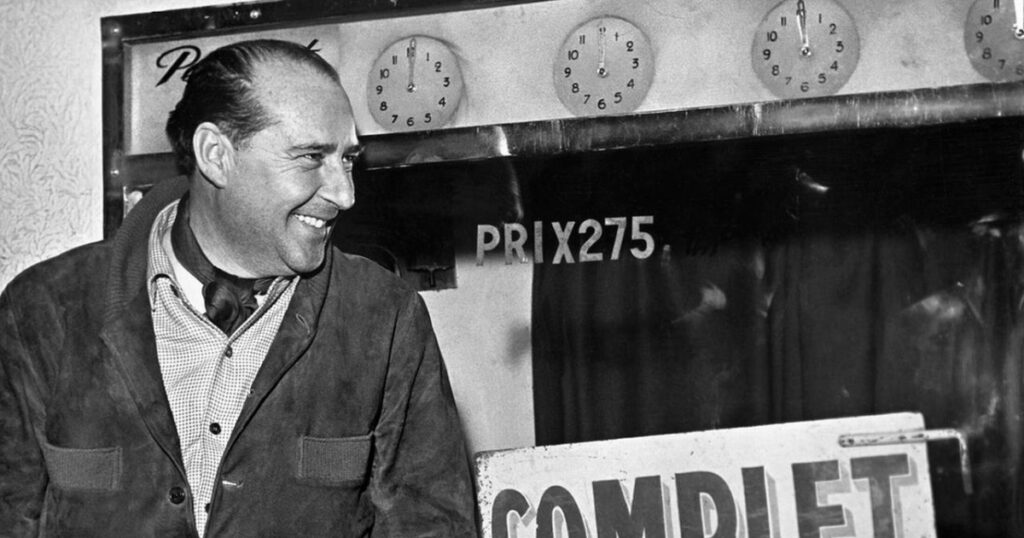
Rome, 1906. Roberto Rossellini is born in the capital into a well-off family. He himself opens this monograph, recalling that he began working in cinema in 1933. From documentaries to screenplays, at some point he feels the urge “to make a bit of a mess playing with the camera”. That “mess” would change the history of world cinema.
In 1945 “Rome, Open City” launches Neorealism: shot in the streets, with non-professional actors, salvaged film stock and makeshift means, it depicts the Nazi occupation with a force that shakes the world. “Paisan” (1946) and “Germany, Year Zero” (1948) follow: the “war trilogy” that redefines the language of cinema.
His first wife, Marcella De Marchis, recalls that the marriage did not last long, partly because “there were women even under the bed”. Rossellini is a man of overwhelming passions, in cinema as in life. His meeting with Ingrid Bergman in 1949 causes a scandal: she leaves Hollywood, he leaves his wife, and a love is born that produces six films and three children – including Isabella.
The critic Adriano Aprà says that for Rossellini making a film was like going on an outing. The director himself admits he did not like screenplays “written at a desk”. Ugo Pirro recalls how, on the set of “Viva l’Italia”, Rossellini read Banti’s “I Mille” and set up the scenes to be shot from that book: cinema as improvisation, as discovery.
After the Bergman years, Rossellini devotes himself to educational television: “The Iron Age”, “Man’s Struggle for Survival”, and portraits of Socrates, Pascal, Louis XIV and Descartes. Cinema as a tool of knowledge.
This documentary gathers extraordinary testimonies: Ingrid Bergman herself, his daughter Isabella, Martin Scorsese and François Truffaut (his spiritual heirs), fellow directors Francesco Rosi and Carlo Lizzani, and the critics Tullio Kezich and Gianluigi Rondi. A chorus of voices telling the story of a revolutionary of cinema.
Roberto Rossellini passed away in 1977. His teaching continues to illuminate world cinema.
Participants (interview cast)
- Roberto Rossellini (archive footage)
- Salvador Allende (archive footage)
- Adriano Aprà
- Ingrid Bergman (archive footage)
- Ettore Bernabei
- Giuseppe Ferrara
- Indira Gandhi (archive footage)
- Vittorio Giacci
- Carlo Lizzani
- Tullio Kezich
- Luca Magnani
- Franco Mariotti
- Marcella De Marchis
- Giuseppe Palermo
- Alfonso Pasca
- Daniele Pettinari
- Adriano Pintaldi
- Ugo Pirro
- Gianluigi Rondi
- Francesco Rosi
- Alessandro Rossellini
- Isabella Rossellini
- Martin Scorsese
- Padre Saverino
- Marco Cesarini Sforza
- François Truffaut (archive footage)
- Madeleine Truffaut
- Mario Vitali
- Jonathan Zonin
Credits
Screenplay, editing and direction: Donatella Baglivo
Assistant director: Maurizio Baglivo
Research and documentation: Antonella Valeriani
Executive producer: Adriano Zonin
Directors of photography: Edmondo Pisani, Roberto Romei
Camera operators: Alfonso Feliziani, Roberto Lanciotti
Camera assistant: Antonio Lalli
Sound technicians: François Mazzon, Paolo Panno
Audio mixing: Maurizio Baglivo
Digital editing: Maurizio Baglivo
Soundtrack editing: Giuseppe Gandolfo
Titles: Stuart Mabey
Opening theme music: Pietro Grignani
Original music: Pietro Grignani, Giuseppe Gandolfo
Film archive manager: Silvano Brugnorotto
Historical archive manager: Kemal Tugal
Foreign film research: Jonathan Eugenio Zonin
Negative archive manager: Bianca Pupella
Production and post-production: CIAK 2000 S.r.l.
Music publishing: CIAK 2000
Copyright: 2000
Co-production: Mediterranea Productions
Running time: 95′
Restoration: 2025 with previously unseen material